
Ceramic
Bearings
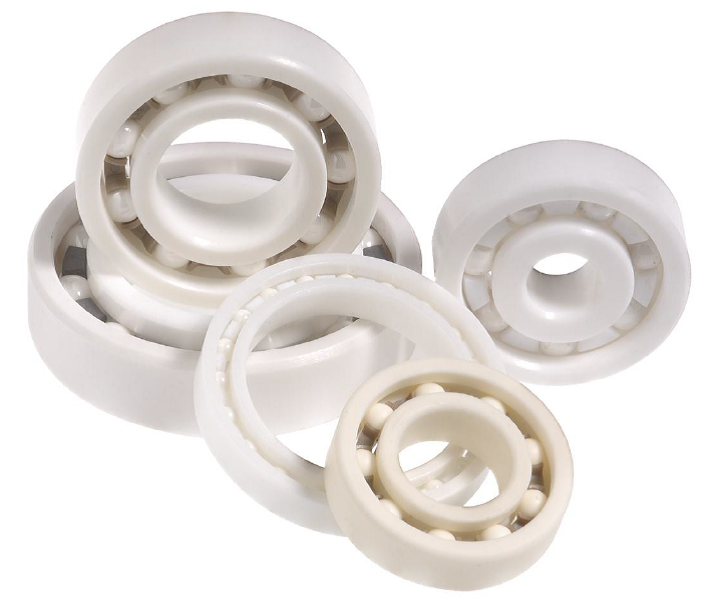
Ceramic bearings are used to reduce failure rates in industrial systems exposed to heat, wear, and chemical environments.
Sintertechnik improves bearing performance through material selection and application-specific bearing design.
The Problem
Why Bearing Failures Occur in
Industrial Systems
Incorrect material selection
Use of standard catalogue bearings in non-standard conditions
Applications
Industries
- Aerospace Engineering
- Industrial Machinery and Equipment
- Turbo Pumps
- Chemicals Industry (Aggressive Media)
- Metalwork Industry (High Operating Temperatures)
- Pharmaceuticals Industry
- Medical Technology
- Food Industry
- Precision Measurement Technology
- Semiconductor Industry and Biotechnology
In aerospace, every component has to perform under extreme conditions: high speeds, vacuum, and fast-changing temperatures, with no room for error.
Our ceramic bearings are engineered for exactly these challenges. They are lightweight, so they handle high speeds with less strain. They maintain precision under rapid thermal changes and perform reliably in vacuum conditions, where standard steel bearings often fail.
This is why our high-performance ceramic bearings are trusted in zero-gravity flight testing and have even been used in the first wheeled vehicle to operate on Mars.
Turbo pumps operate at extremely high speeds, often with limited lubrication. Standard steel bearings quickly generate heat and wear under these stresses.
Our ceramic bearings are designed for high-speed, low-lubtrication environments. Their low weight and excellent dry-running properties reduce heat generation and wear, enabling higher speeds and longer operating life.
Our ceramic materials, including silicon nitride and zirconium oxide, offer outstanding chemical resistance. They maintain strength and precision even under continuous exposure to corrosive substances. In many cases, the process fluid itself can act as a lubricant, eliminating the need for additional lubrication systems.
Our ceramic bearings are designed to handle this heat. They maintain their strength and precision at temperatures up to 1,000°C and beyond, so your equipment keeps running smoothly even in the most thermally demanding parts of your process.
Our full ceramic bearings operate dry or with minimal lubrication, are chemically inert, and do not release metallic particles. This makes them ideal for reactors, dosing systems, and cleanroom production environments.
Our ceramic bearings meet all of these requirements naturally. They are non-magnetic, electrically insulating, and manufactured to the strict cleanliness standards medical applications need, making them a dependable choice for precision medical devices and laboratory systems.
Our ceramic bearings resist corrosion from cleaning agents and moisture. They operate without oil-based lubrication, reducing contamination risk, and withstand repeated washdown cycles, supporting both hygiene and long-term equipment performance.
Our ceramic bearings expand less than steel when temperatures change, and they maintain tighter tolerances over time. This keeps your instruments precise, even as conditions around them change.
Our full ceramic bearings can operate completely dry and do not release particles like worn steel bearings. This makes them one of the few bearing solutions suitable for cleanroom-grade, contamination-free applications.
How We Define Bearing Performance
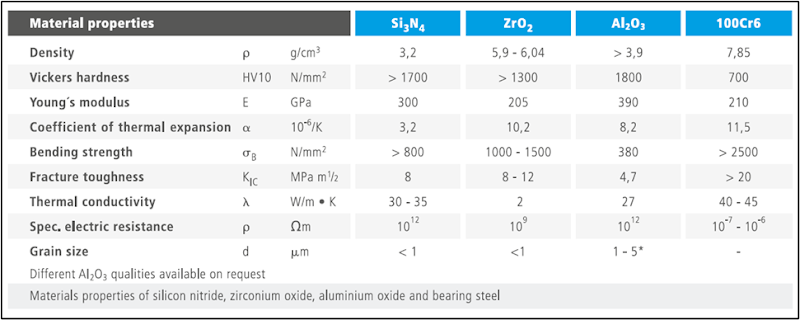
Choose the Right Material
Silicon Nitride (Si₃N₄)
Used for high-speed, high-load, and precision applications.
Zirconium Oxide (ZrO₂)
Silicon Carbide (SiC)
Aluminum Oxide (Al₂O₃)
View Detailed Material Properties
Still unsure which material fits your application?
Our material scientists analyze your complete operating profile and recommend the ceramic material that provides the best match between performance requirements and economic efficiency.
Standard & Custom Solutions
Choose the Right Bearing Design -
Standard and Custom Solutions
Bearing selection defines how loads, speeds, and environmental conditions are handled in operation.
Sintertechnik provides both standard ceramic bearings and custom-engineered solutions.
Full Ceramic Bearings
Explore Product
Full ceramic bearings are manufactured with both rings and rolling elements made entirely from advanced technical ceramics. Their unique properties make them ideal for applications where standard steel bearings cannot meet requirements for corrosion resistance, temperature stability, electrical insulation, or dry-running operation .
Applications
Full ceramic bearings are commonly used in:
- Chemical processing equipment
- Semiconductor and cleanroom applications
- Food and pharmaceutical machinery
- Medical technology
- High-temperature and vacuum environments
- Systems requiring dry or minimal lubrication operation
Key Benefits
- Can operate reliably with little to no lubrication, including dry-running condition depending on design and material selection
- Resistant to acids, alkalis, and aggressive chemicals
- Can withstand temperatures up to 1,000°C and beyond depending on material and design
- Electrically insulating and non-magnetic
- Produce no metallic wear particles, supporting contamination-sensitive applications[b]
Hybrid Bearings
Explore Product
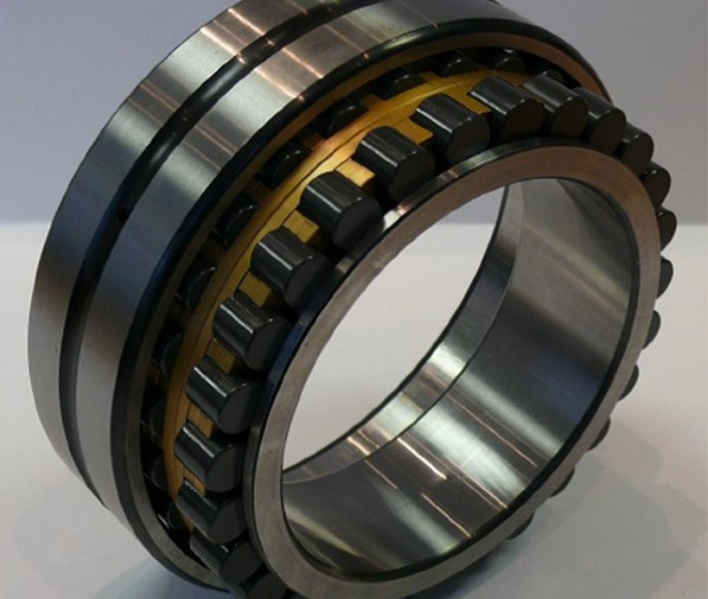
Hybrid ceramic bearings combine steel rings with ceramic rolling elements, providing a balance between the cost efficiency of steel and the low friction, lightweight advantages of ceramics. They are an effective solution for applications where full ceramic performance is not required but improved speed, efficiency, and service life are important.
Applications
Hybrid ceramic bearings are commonly used in:
- Industrial machinery and equipment
- Electric motors and generators
- Pumps and rotating equipment
- High-speed applications
- Systems requiring improved efficiency and reduced wear
Key Benefits
- Lower friction and reduced heat generation compared to steel bearings
- Can support higher operating speeds, with improvements of up to 30% possible depending on application.
- Reduced wear due to lower friction between ceramic and steel components
- Cost-effective solution for extending bearing service life
- Higher dielectric strength helps protect against electrical arcing
Angular Contact Bearings
Explore Product
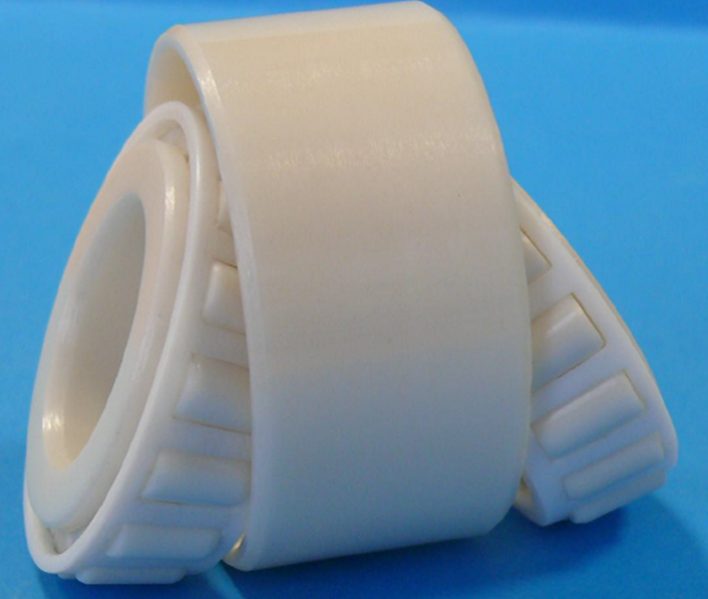
Angular contact bearings are designed to support both radial and axial loads simultaneously through their angled contact geometry. They are ideal for high-speed and precision applications where stability, accuracy, and load handling are essential.
Applications
Angular contact bearings are commonly used in:
- Machine tool spindles
- Precision machinery
- Robotics
- High-speed rotating equipment
- Applications with combined loading conditions
Key Benefits
- Support radial and axial loads simultaneously
- Maintain precision during high-speed operation
- Reduce the need for additional bearing arrangements
- Available in ceramic designs for improved heat resistance
- Provide enhanced corrosion resistance in demanding environments
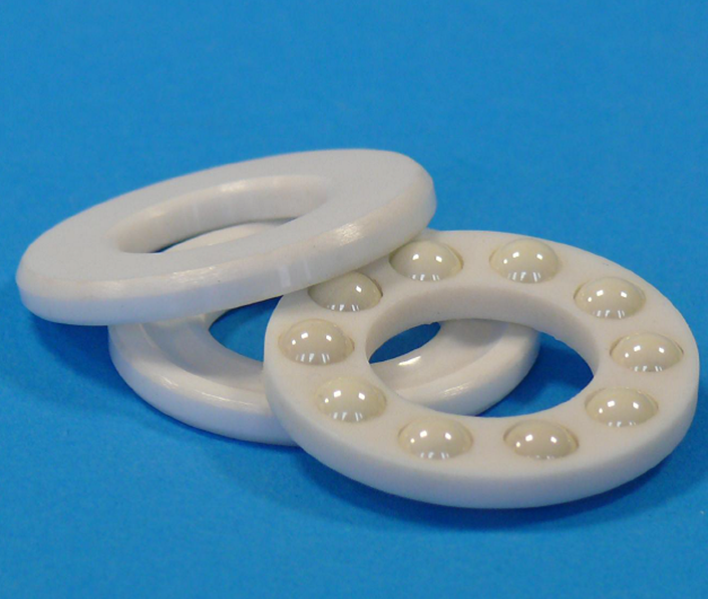
Axial/Thrust Bearings
Explore Product
Axial or thrust bearings are specifically designed to support loads acting along the axis of rotation. They are used in applications where axial forces must be managed separately from radial loads, especially in demanding environments.
Applications
Axial/thrust bearings are commonly used in:
- Pumps
- Vertical shafts
- Turbines
- Heavy machinery
- High-temperature applications
Key Benefits
- Designed specifically for high axial load requirements
- Available in full ceramic construction for extreme temperatures
- Maintain performance where conventional bearings may fail
- Can be combined with radial bearing solutions in systems requiring both axial and radial load support
- Can be combined with radial bearing solutions for complex systems
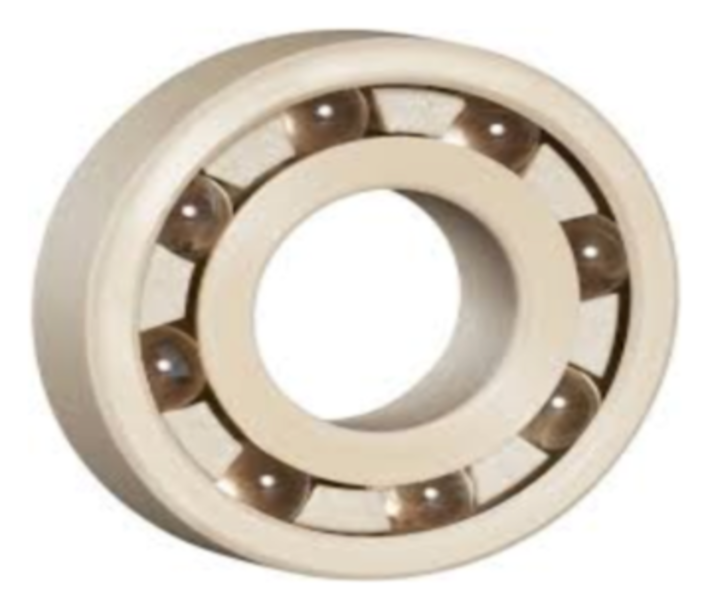
PEEK Cage Bearings
Explore Product
PEEK cage bearings use a high-performance polymer cage combined with ceramic or hybrid bearing designs. The lightweight and chemically resistant properties of PEEK make these bearings suitable for demanding industrial applications requiring reliable operation under varying temperatures and aggressive environments.
Applications
PEEK cage bearings are commonly used in:
- Chemical processing equipment
- Food and beverage machinery
- Industrial applications with demanding environments
- Systems requiring lightweight, chemically resistant components
Key Benefits
- Excellent resistance to chemicals and aggressive process media
- Stable performance across a wide temperature range
- Lightweight design reduces rotational inertia
- Smooth operation with low friction
- Suitable for demanding industrial environments
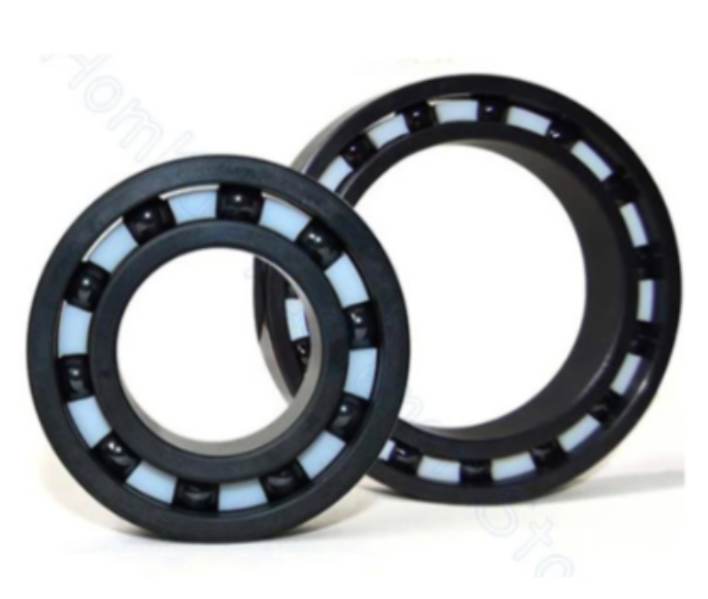
PEEK Cage Bearings
Explore Product
PTFE cage bearings combine ceramic or hybrid bearing designs with PTFE cages, which are known for low friction and excellent chemical resistance. They are designed for precision applications where smooth operation, minimal lubrication, and reliable performance are essential, while high speed and heavy loads are not.
Applications
PTFE cage bearings are commonly used in:
- Precision instrumentation
- Small electric motors
- Sensitive process equipment
- Chemical environments
- Applications requiring low or no lubrication
Key Benefits
- Extremely low friction for precision operation
- Strong resistance to chemicals and moisture
- Self-lubricating properties support dry-running applications
- Suitable for small, high-precision bearing designs
- Reliable performance in demanding environments
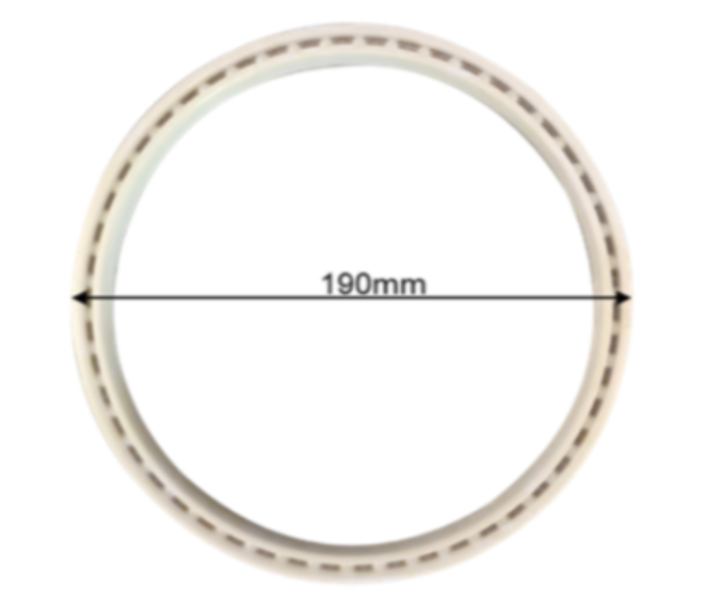
Large Diameter Bearings
Explore Product
Large diameter ceramic bearings are engineered for large-scale applications, with outer diameters that exceed standard catalogue sizes. Their ceramic construction provides performance advantages in large-scale rotating equipment exposed to demanding operating conditions.
Applications
Large diameter ceramic bearings are commonly used in:
- Power generation equipment
- Turbines
- Heavy industrial machinery
- Large rotating systems
- High-load applications
Key Benefits
- Support demanding loads while offering weight advantages compared with steel equivalents
- Maintain precision and stability at large sizes
- Withstand thermal and mechanical stress
- Reduce centrifugal forces compared to steel bearings
- Provide reliable performance in demanding environments
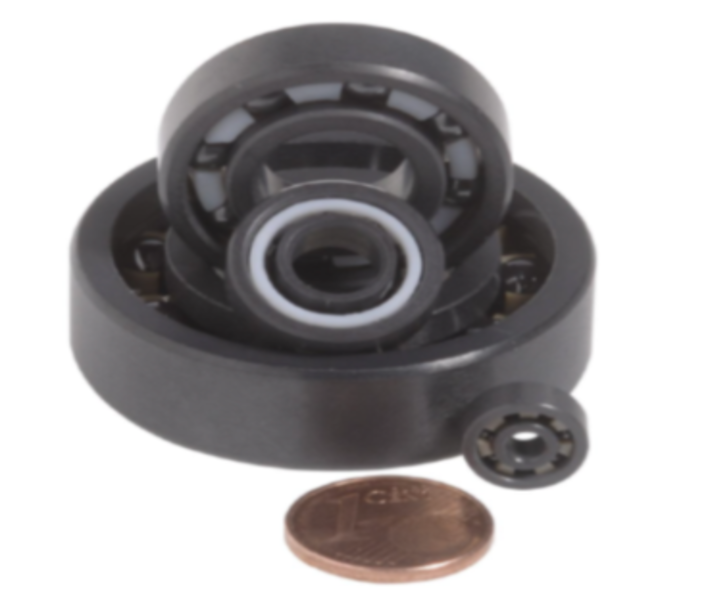
Miniature Bearings(Micro-Sized)
Explore Product
Miniature ceramic bearings are compact bearings designed for small, high-precision applications where space is limited but reliability, speed, and accuracy remain critical. Their lightweight ceramic construction enables efficient operation in demanding miniature systems.
Applications
Miniature ceramic bearings are commonly used in:
- Small DC motors
- Medical devices
- Precision instruments
- Laboratory equipment
- Compact high-speed mechanisms
Key Benefits
- Reliable performance in extremely small designs
- Lightweight construction supports high-speed operation
- Precise and consistent movement in limited spaces
- Reduced friction compared to many conventional steel miniature bearings
- Durable performance under demanding conditions
View Standard Specifications
| Specification | Range |
|---|---|
| Outer Diameter | 7 mm – 200 mm+ |
| Precision Classes | P0, P6, P5, P4 |
| Temperature Range | -260°C to +1000°C |
| Cage Materials | Ceramic, PEEK, PTFE, Stainless Steel, Cageless |
| Compatibility | ISO-compliant dimensions |
CUSTOM ENGINEERING
Custom Bearing Engineering Through
FEA Simulation
How Simulation Works
Requirements Analysis
We define your actual operating conditions through direct engineer-to-engineer collaboration, including temperature, load, speed, chemical exposure, contamination, and lubrication constraints.
Digital Simulation (FEA)
A digital twin of your bearing is created and tested under operating conditions. We simulate stress distribution, thermal effects, contact pressures, and tribological interactions.
Failure Mode Identification
The simulation identifies exactly where and why standard bearings fail:
- Thermal expansion causing interference
- Contact stresses exceeding material limits
- Lubrication breakdown under operating conditions
- Geometry-induced pressure concentrations
Design Optimization
We resolve these issues before manufacturing. Material selection, geometry, tolerances, and surface treatments are optimized based on simulation data, not assumptions.
Validation & Production
Prototypes are tested against simulation results and scaled to production with consistent, repeatable results.
QUESTIONS
Frequently Asked Questions
GENERAL
Materials & Bearing Types
Performance & Operating Conditions
Operating Environment
Engineering & Custom Solutions
Installation
What are ceramic bearings used for?
Ceramic bearings allow application in systems exposed to high temperature (heat, wear), vacuum or many liquid environments like sea-water or aggressive chemicals. Up to 40% of machinery breakdowns are linked to bearings, typically due to incorrect material selection or using standard catalogue bearings in non-standard conditions. Failure risk is reduced when material and bearing design are matched to actual loads, speeds, and environment.
What advantages do ceramic bearings have over steel bearings?
Ceramic bearings offer measurable advantages over steel:
- Very low friction — smooth running
- Low or zero maintenance — media-lubrication and zero lubrication are both possible
- Long service life — high wear resistance
- Up to 60% lower weight than equivalent steel bearings
- High corrosion resistance
- High hardness and stiffness
- Non-magnetic
- High temperature stability
These properties make them suitable where steel bearings reach mechanical, chemical, or thermal limits.
Which industries use ceramic bearings?
- Aerospace
- Machinery & equipment
- Turbo pumps
- Chemical processing (aggressive media)s
- Metalworking (high temperatures)
- Pharmaceuticals & medical technology
- Food industry
- Precision measurement
- Semiconductor & biotechnology (clean-room, no lubricant contamination)
These properties make them suitable where steel bearings reach mechanical, chemical, or thermal limits.
What ceramic materials are available?
Four technical ceramics are used:
- Silicon Nitride (Si₃N₄): high-speed, high-load, low weight; broadest range
- Zirconium Oxide (ZrO₂): cost-efficient, can be combined with steel, (moderate load)
- Silicon Carbide (SiC): for seawater or extreme chemical conditions
- Aluminum Oxide (Al₂O₃): economical for sliding wear parts
There is no universal best material, only the correct match for your application.
Which material is best for my application?
What is the difference between hybrid and full-ceramic bearings?
Full-ceramic bearings use ceramic rings and rolling elements, enabling full performance in high temperatures, aggressive media, vacuum, and non-magnetic applications.
Hybrid is a cost-efficient upgrade for standard environments; full ceramic is used for demanding conditions.
Are ceramic bearings non-magnetic?
What defines bearing performance?
Performance is defined by:
- Rotational speed (operating and peak)
- Static load
- Axial load
- Dynamic load
These are the primary inputs for correct selection or design. Performance also depends on material, geometry (clearance, tolerance), cage configuration, temperature, lubrication, and environment.
What sizes and specifications are available?
- Outer diameter: 7 mm to 200+ mm
- Precision classes: P0, P6, P5, P4
- Cage options: ceramic, PEEK, PTFE, stainless steel, or cageless, special polymers
- Temperature range: -260°C to +1000°C
- ISO-compliant dimensions
Custom dimensions and configurations are available.
Are Sintertechnik ceramic bearings ISO-compliant?
What temperature range can ceramic bearings handle?
Temperatures above 400°C are only achievable with full contact (cageless( or full-ceramic)) bearings.
Why must I specify the main application temperature?
Different materials expand at different rates, so clearance must be calculated for actual operating temperature.
Can a standard ceramic bearing handle axial (thrust) load?
Can ceramic bearings operate in a vacuum?
Load and speed must always be specified to determine the correct configuration.
Do ceramic bearings need lubrication?
Not necessarily. Three modes are possible:
- Dry running — required in vacuum and clean-room environments
- Media lubrication — process fluid acts as lubricant
- Conventional lubrication — extends service life, especially for hybrid bearings
Selection depends on environment, contamination limits, temperature, and speed.
Can ceramic bearings be used in chemical environments?
Applications involving chemical mixtures are classified as experimental, as compatibility cannot be reliably predicted and must be validated through testing. Full media composition is required.
Can custom ceramic bearings be developed?
What information is required for an engineering evaluation?
Provide:
- Rotational speed (operating and peak)
- Static and dynamic load (radial and axial)
- Main application temperature
- Environment (vacuum, chemicals with full composition, no contamination by particles allowed)
- Mounting method
- Accurate inputs improve simulation accuracy and reduce failure risk.
How should ceramic bearings be installed?
Preferred method: bonding (gluing) onto the shaft
Avoid:
- Tensile stress on bearing rings
- Vibrations within the setup or machine
- Impacts (e.g., hammer blows during installation)
- For elevated temperatures, a ceramic shaft is needed
Improper installation can cause premature failure before operation.
Ready to stop bearing failures?
Get Your Free
Consultation Now
Discover how precision-engineered ceramic bearings can dramatically reduce downtime and extend the life of your machinery.
Our experts will analyze your operating conditions and recommend the perfect solution (customized, validated, and performance-proven).

Send us a message
Have a specific bearing requirement? Submit your details and we’ll get back to you.

Where Mars-proven technology elevates engineering on Earth.
Germany · HQ
Sintertechnik AG
Altreuthstr. 18
91362 Pretzfeld
Germany
+49 9194 9550
Germany · Pottenstein
Am langen Berg 8
91278 Pottenstein
Germany
+49 9194 797533
THAILAND · ASIA
Quality Quantity Quickly Co., Ltd.
196 Phetkasem Road
Nong Kang Phlu, Nong Khaem
Bangkok 10160, Thailand